
Let’s play a game. I’ll show you two similar player profiles on Baseball Savant, and you’ll think about who you would rather have on your favorite team.

Player 1 has his positive and negative attributes. While this mystery player has elite contact-hitting and pitch identification skills, his power stats are terrible, only being in the 4th percentile for barrel percentage (a measure of hard contact that typically leads to extra-base hits). While this player’s offensive profile seems to indicate he would be a perfect leadoff hitter for a contending team, he is only in the 25th percentile for sprint speed. His defense is pretty bad too, good for only the 2nd percentile in outs above average. This player’s profile is weird, to say the least, but this player is having incredible success on “back-of-the-baseball card” stats like batting average and on base percentage.

Player B has a very similar offensive profile. The most notable difference is that player B is in a much higher percentile for barrel %. The general trend is that player A is in slightly higher percentiles for measures of contact like xBA (expected batting average) and xWOBA (an expected on-base average measured by the type of contact the player makes), while player B is in slightly higher percentiles for stats that measure power like exit velocity, barrels, and xSLG (expected slugging percentage). Overall, though, you would expect both players A and B to have nearly identical outcomes based on the analytics. Right?
Wrong. Player A is Luís Arráez, the starting second baseman for the National League All-Star team this year. Arráez has done nothing but hit since he was called up to the Major Leagues in 2019. After four years with the Twins where his lowest batting average was .294, Minnesota traded him to the Marlins for Pablo López. Arráez has only gone on to have one of the most impressive seasons in recent memory, at times flirting with a .400 batting average and running a mind-boggling strikeout percentage of just 5.24% in 362 plate appearances. Arráez’s recent stat-lines are comparable to prime Tony Gwynn, a refreshing return to the art of small-ball in the age of high-power, high-strikeout types like Kyle Schwarber and Pete Alonso. And of course, we’re talking about someone who fans voted to represent the National League as a starter in the All-Star Game. MLB Network talking heads fill airtime by proposing that Arráez’s season is Cooperstown-worthy — an insane take, sure, but the baseball world has taken note of Luis Arráez. After years of futility and mediocrity, Arráez is leading the Marlins’ renaissance into the second half as they make a serious playoff push.
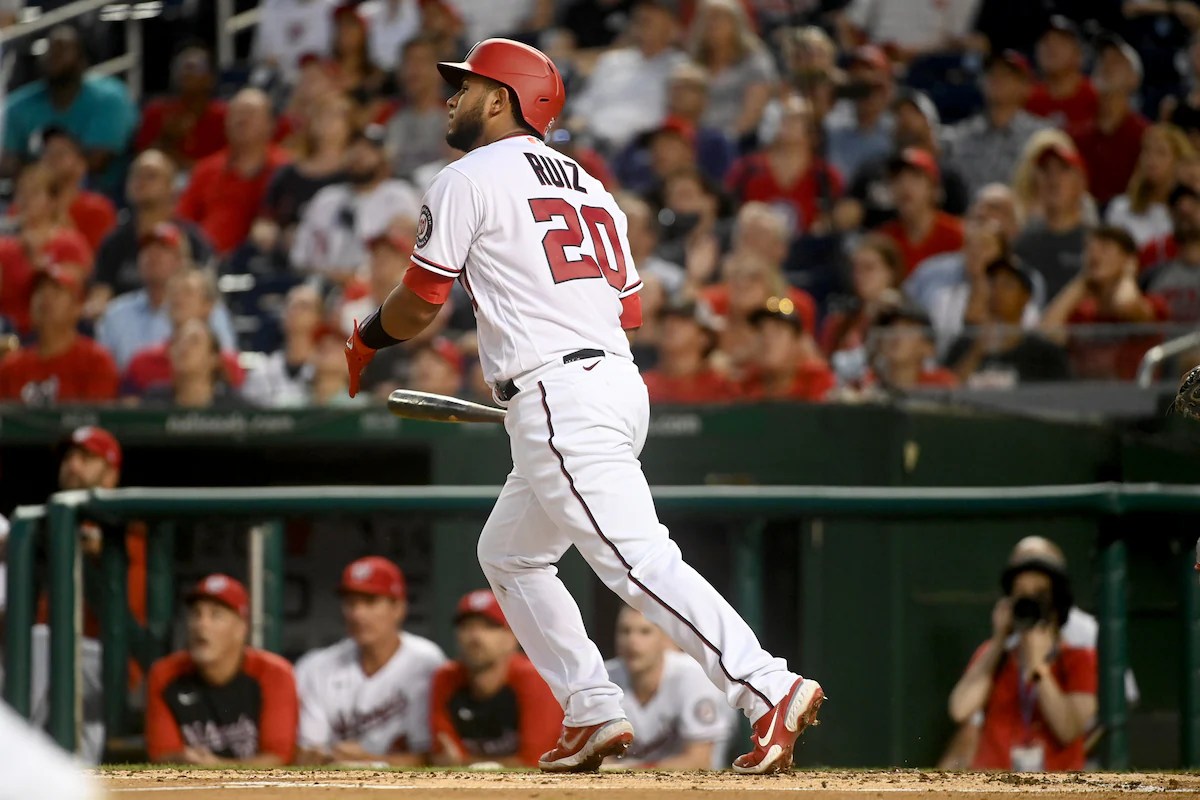
And as you probably expected based on the title of this article, Player B is Keibert Ruiz. Nats fans know well that this year has not gone the way the Nats’ backstop expected it to go. In his second year as the Nats’ full-time catcher since he was acquired from the Dodgers in the Max Scherzer/Trea Turner trade, Ruiz has suffered serious regression, hitting just .226 while playing some of the worst defense of his professional career (for more on Ruiz’s defense, this article by Andrew Golden of the Washington Post is spectacular). Ruiz has been far, far less successful than Arráez this year, with some loud critics demanding more playing time for backup Riley Adams or top minor league catching prospect Drew Millas.
Baseball is such a bizarre, yet fascinating, sport because of anomalies like this. The two Venezuelans are nearly identical players when it comes to advanced stats, yet one is the shoe-in for the NL batting title, while the other is struggling to hit above the Mendoza line. I spent a good 20 minutes trying to figure out what the difference between Arráez and Ruiz is. Is there anything mechanically that Arráez is doing that Ruiz should learn from? Is the contact that Arráez is making better than Ruiz’s contact, “better” defined by either empirical data or the eye test? Can it be proven that the physical demand of catching affects Ruiz’s outcomes? It feels like Ruiz grounds out softly a lot — does the Marlin hit the ball harder? Does Arráez hit fewer ground balls? Are there any statistically significant data points that could explain why Arráez is dominating the league while Ruiz is mired in a sophomore slump?
The answer is no, no there are not. It’s possible, probable even, that both Arráez and Ruiz are having seasons that can only be described as a statistical anomaly. Even still, it’s difficult to understand the extremely different nature of the two players’ outcomes.

Just so you all know I’m not making this up, this chart represents Arráez’s batted ball profile. The blue, green, and orange circles represent poor contact under the ball, poor contact on top of the ball, and bloop or flare hits, respectively. The arrows out to other players indicate the five most similar batted ball profiles to Arráez across the league. You expect to see other players known for high average and relatively low power, such as Jeff McNeil and Nico Hoerner. And of course, there’s our Keibert, tied with Arráez’s Marlins teammate Yuli Gurriel for the fourth most similar profile to the All-Star starter.
Just to be clear, this batted-ball profile is not by any means the best in baseball — take a look at Ronald Acuña Jr’s Baseball Savant page and you’ll understand why I think he’s the best all-around hitter in baseball at the moment. The ideal outcome for an at-bat is a barrel (represented by the red circle on the chart). Barrels can be singles or extra base hits, but the defining characteristic of a barrel is that the batted ball has an xBA above .500 — essentially, it will land for a hit more than half the time. The best hitters in baseball hit the most barrels. Aaron Judge hits a barrel in 16.4% of his plate appearances, good for the best rate in the Major Leagues. Luis Arráez is 16th-WORST in baseball in this statistic, only hitting a barrel in 1.9% of his PAs.
Would you like to guess who leads the Nationals in barrels per plate appearance?
It’s Keibert Ruiz.
He’s good. Really good, in fact. We’re talking about a hitter who, in his age-24 season, almost never strikes out, has the contact skills of Luis Arráez, and hits the exact same percentage of barrels as Nolan Arenado, Manny Machado, and Ozzie Albies.
He’s just unlucky.
A barrel might be the ideal outcome for a plate appearance, but by far, the best outcome is to simply get on base. And to do that, as Yogi Berra said, you have to “hit it where they ain’t.” For every time Ruiz makes perfect contact but lines out directly to the shortstop, Arráez hits two bloop singles with terrible launch angles and low exit velocities. This is the problem with evaluating hitters using batting average — for players like Ruiz and Arráez, they can be making the exact same type of contact with similar walk rates, yet one wins the batting title when the other is still yet to experience his offensive breakout in the MLB. Ruiz is not a better player than Arráez, but to say that Arráez is far and away better than Ruiz using batting averages as justification is to ignore the underlying statistics that separate the two.
So give Keibert Ruiz some time. The same way that Arráez’s season is unsustainable over a long period of time, Ruiz’s struggles in 2023 will not extend throughout his entire career, so long as the baseball gods are merciful. He’s under contract in Washington for a long time, and there is not much depth in the organization at catcher — maybe we’re forced to be patient with Keibert, but I feel confident that one day, Ruiz will match the offensive production that his advanced stat profile indicates he can reach.
Categories: Uncategorized
 Matt's Bats
Leave a comment